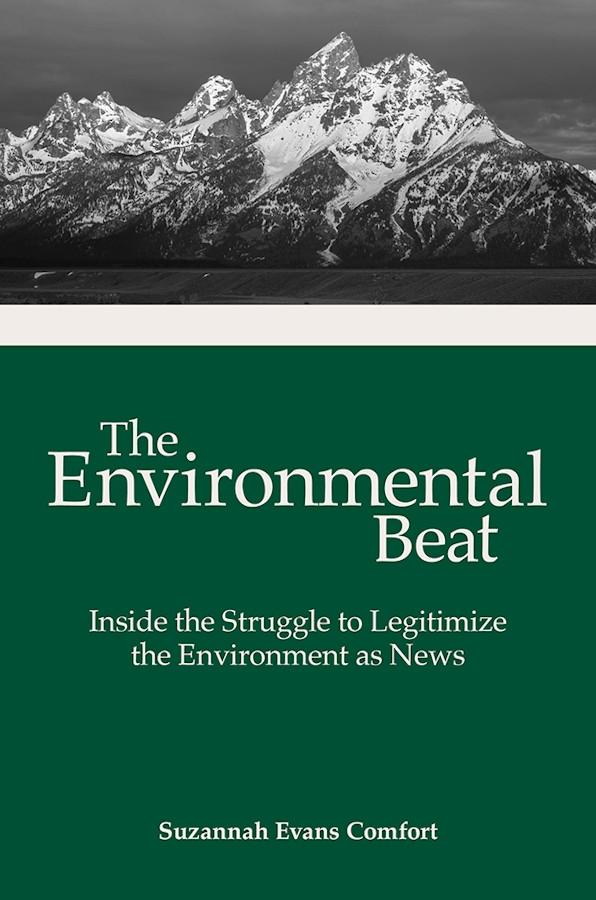

The most important story of our time is also one of the most underreported.
Environmental problems have plagued American communities for generations, and yet most news organizations fail to prioritize covering environmental issues beyond major disasters. This allows crises of pollution, climate change, and biodiversity loss to continue affecting our communities as news attention is a key component of social and policy change.
In The Environmental Beat: Inside the Struggle to Legitimize the Environment as News, Suzannah Evans Comfort reveals how environmental issues are often a poor fit for the corporate nature of most U.S. newsmaking. This book is the first to explain why environmental beat reporters are rarely found in the U.S. media landscape – and why they often find themselves on the outside looking in, seeking scant institutional support and fighting for professional legitimacy.
About the author

Suzannah Evans Comfort (Ph.D, The University of North Carolina) is an associate professor of journalism at the Media School at Indiana University. Her research examines the sociology of journalism, including the economic, social, and organizational influences on journalism production. Prof. Comfort probes the gap between normative assumptions of journalism – how it should function as an independent force in democratic society – and realities for journalists, who face both structural and professional constraints on their work.
In addition to her research on environmental journalism, Prof. Comfort also recently produced the first-ever news ecosystem report on the state of Indiana: Journalism at the Crossroads of America.
Table of contents
3
Introduction
35
Advocacy: Still Uncomfortable After All These Years
87
Outsiders; Or, the Unexpected Pioneers of Environmental Journalism
119
What Causes News Organizations to Invest in Environmental Journalism?
189
The Political Economy of Environmental Journalism
245
Remaking Environmental Journalism For Today
273
Conclusion
Praise for The Environmental Beat
As environmental reporting moved from the fringes of the media to a central place in many newsrooms, it encountered increasing levels of resistance and misinformation, along with declining support in a precarious media landscape. Journalists hoping to take the environmental beat into the future are well advised to acquaint themselves with its long history, the old challenges it continues to confront even as it faces myriad new pressures.
With astute analysis of the news industry, a thorough study of the history of the environmental beat, and engagement with scores of working environmental journalists, Suzannah Comfort has provided an invaluable guide of how the environmental journalism ecosystem developed, what has helped it grow, and how the most important beat on the planet can not only chart a course into the future, but possibly even improve it.
– Michael Kodas, senior editor, Inside Climate News
The Environmental Beat gives one of the most important and often under-examined areas of journalism its due. Suzannah Evans Comfort brings sharp perspective and critique as she examines the history, challenges, and future of environmental journalism— one of the most complex beats in the newsroom. This is essential reading for working or aspiring environmental journalists and journalism scholars.
– Sadie Babits, senior supervising climate editor at NPR and author of Hot Takes: Every Journalist’s Guide to Covering Climate Change
Written in lively, accessible prose, The Environmental Beat makes a compelling case not only for why environmental journalism matters, but how it can reconnect us to one another and to the world we share. Suzannah Comfort’s historical account of the challenges faced by writers and newsrooms to produce essential stories about environmental problems offers valuable lessons for scholars and journalists at a time of institutional transformation.
Illuminating the vital role of reporting on issues from conservation to climate change, The Environmental Beat provides insights for a new generation of environmental journalists to forge a sustainable, ethical future.
– Dr. Melissa Aronczyk, Professor, School of Communication and Information, Rutgers University, and co-author of A Strategic Nature: Public Relations and the Politics of American Environmentalism
Utilizing the tools of historical sociology, Suzannah Evans Comfort offers the first sweeping view of the development of environmental journalism over two centuries. The Environmental Beat sings with insight into the entanglements of journalism and advocacy, sport and culture, and news and business. Suzannah Evans Comfort has written a necessary book that helps environmental journalists understand their labor and struggles, and our moment, in the arc of historical time. She provides scholars with a groundbreaking look into the many forces that shape what is legitimate journalism and ultimately matters of public concern.
This book could not be more urgent. As wildfires light night skies, oceans rise with the melting of glaciers, and hurricanes rage hundreds of miles from the ocean, The Environmental Beat shows how professional standards push environmental journalists to the margins, away from the urgency of the moment.
– Dr. Daniel Kreiss, Edgar Thomas Cato Distinguished Professor, Hussman School of Journalism and Media,
The University of North Carolina